
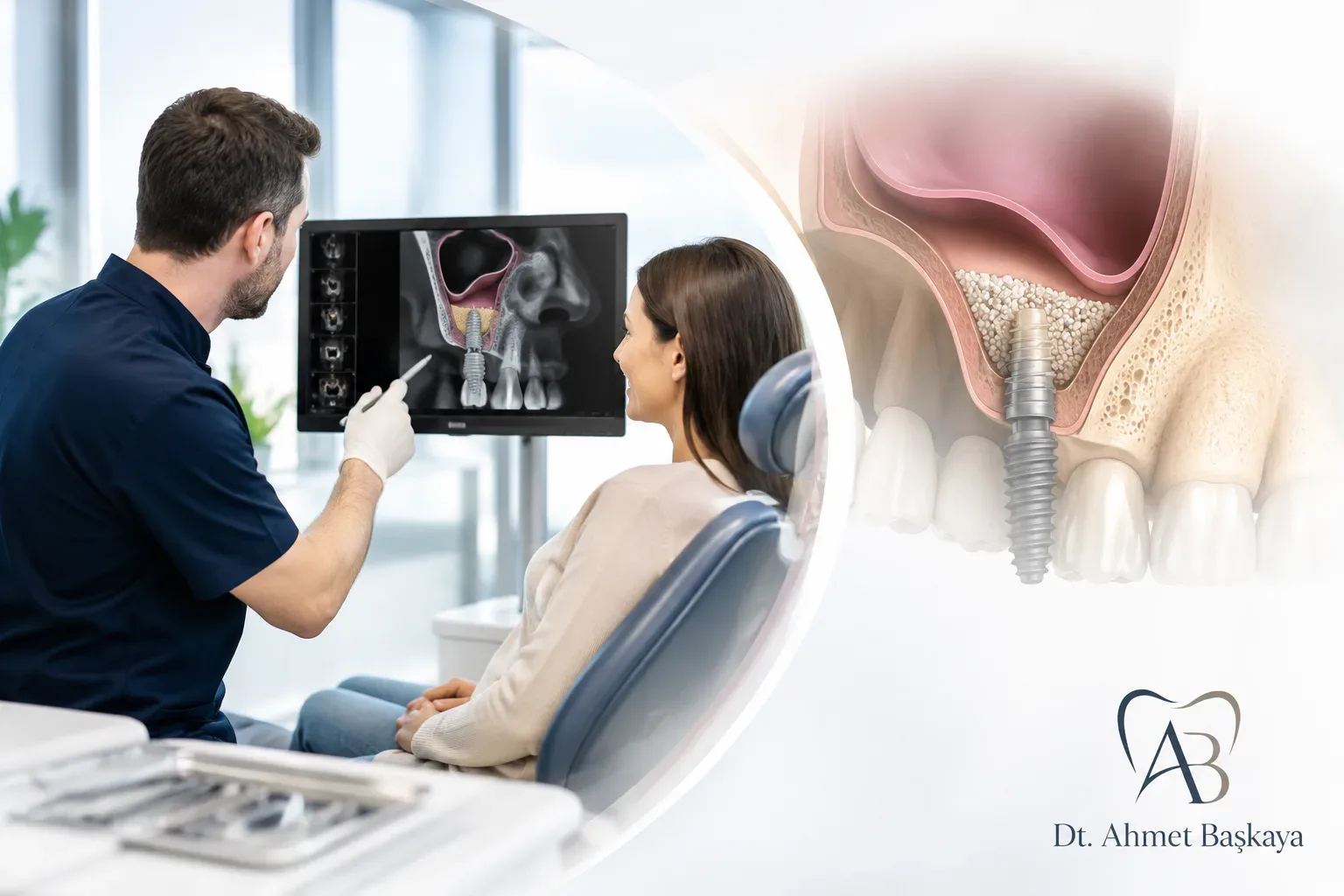
Sinus Lift
A sinus lift is one of the bone augmentation techniques used when there is insufficient bone height for implant treatment in the posterior region of the upper jaw. A decrease in bone volume following tooth loss or downward expansion of the maxillary sinus cavity can make implant placement difficult. In such cases, the goal of a sinus lift procedure is to create a more suitable bone area for the implant by elevating the sinus floor in a controlled manner.
For patients in Bursa seeking sinus lift treatment, it is crucial that the procedure be performed with detailed imaging and a personalized treatment plan. This is because each patient’s upper jaw bone structure, sinus position, implant needs, and degree of bone deficiency may vary. At Vita Dental Clinic, Dr. Ahmet Başkaya analyzes the patient’s bone structure through X-ray or CT scan evaluations to determine which method—open sinus lift or closed sinus lift—is most appropriate.
In this article, we will address frequently asked questions—such as what a sinus lift is, who needs it, what the differences are between open and closed sinus lifts, why a sinus lift is performed before implant placement, and what to consider during the post-sinus-lift care process—in a patient-centered, clear, and reassuring manner.
What Is a Sinus Lift?
A sinus lift is a bone augmentation procedure performed when there is insufficient bone height in the posterior region of the upper jaw for implant treatment. Following tooth loss in the posterior region of the upper jaw, bone volume may decrease, or the maxillary sinus cavity may expand downward. In such cases, there may not be sufficient bone support to safely place an implant.
In a sinus lift procedure, the floor of the maxillary sinus is carefully elevated, and a bone graft is placed in the resulting space as needed to create the appropriate bone volume for the implant. This procedure can serve as a crucial preparatory step, particularly for patients planning upper jaw implant treatment, to ensure the implant is placed on a more stable foundation.
For patients in Bursa seeking sinus lift treatment, a detailed examination and imaging evaluation are of great importance. At Vita Dental Clinic, Dr. Ahmet Başkaya evaluates the patient’s upper jaw bone structure, sinus position, and implant needs using X-rays or CT scans to create a personalized treatment plan. This approach helps ensure that the sinus lift procedure proceeds in a safer, more organized, and more comfortable manner.
Who Needs a Sinus Lift?
A sinus lift may be necessary for patients who are scheduled for implant treatment in the posterior region of the upper jaw but lack sufficient bone height. After losing the back teeth in the upper jaw, bone volume may decrease over time, and the support area required for implant placement may become insufficient. In such cases, a sinus lift procedure may be considered to create a more suitable bone foundation for implant treatment.
Conditions such as bone resorption following tooth loss, prolonged edentulism, downward expansion of the maxillary sinus cavity, or insufficient jawbone density can directly affect implant planning. Especially when implants are to be placed in the posterior region of the upper jaw, the existing bone volume must be sufficient to support the implant. If there is insufficient bone support, a sinus lift may be required prior to implant placement.
Whether a patient requires a sinus lift can be determined not only through a clinical examination but also through imaging methods such as X-rays or CT scans. At Vita Dental Clinic in Bursa, Dr. Ahmet Başkaya creates a personalized treatment plan by thoroughly evaluating the patient’s upper jaw bone structure, sinus position, and implant needs.
How Is a Sinus Lift Performed?
A sinus lift procedure is first planned through a detailed examination and imaging evaluation. During this stage, the bone height in the posterior region of the upper jaw, the position of the maxillary sinus, and the support area required for the implant are examined. Imaging methods such as X-rays or CT scans are used to assess bone volume, and the open or closed sinus lift technique is determined based on the patient’s needs.
During the procedure, the sinus floor is carefully elevated, and a bone graft is placed in the resulting space when necessary. The purpose of this procedure is to create a more suitable bone volume for implant placement in the posterior region of the upper jaw. The sinus lift procedure is performed with great care, taking into account the patient’s jawbone structure and implant plan.
While the sinus lift procedure can be performed during the same session as implant placement in some patients, in other cases it may be planned as a separate procedure prior to implant placement. This decision is based on the available bone volume, the need for bone grafting, implant stability, and the healing process. At Vita Dental Clinic in Bursa, Dr. Ahmet Başkaya thoroughly evaluates the patient’s upper jaw bone structure and plans the sinus lift procedure on a case-by-case basis.
What Is an Open Sinus Lift?
An open sinus lift is a sinus elevation method that may be preferred in cases where bone height in the posterior region of the upper jaw is significantly insufficient. It can be performed, particularly when there is insufficient bone support in the area where implant treatment is planned, to create a more suitable bone volume for the implant. This method is generally considered for patients who require more extensive bone augmentation.
During the open sinus lift procedure, a small window is created in the lateral region of the upper jaw to access the floor of the maxillary sinus. The sinus floor is gently elevated, and a bone graft is placed in the resulting space. The goal is to create the necessary bone support for implant placement in the posterior region of the upper jaw.
Whether to perform the open sinus lift procedure is determined based on the patient’s bone height, sinus structure, implant plan, and overall oral health. For this reason, it is important to make this decision based on X-rays, CT scans, and a detailed dental examination. At Vita Dental Clinic in Bursa, Dr. Ahmet Başkaya evaluates the patient’s upper jaw bone structure and implant needs to plan the open sinus lift procedure on a case-by-case basis.
What Is a Closed Sinus Lift?
A closed sinus lift is a sinus elevation method that can be applied in cases where bone height in the posterior region of the upper jaw is partially sufficient and the need for bone augmentation is more limited. Compared to an open sinus lift, it can be planned for a more limited area and is typically performed through a controlled procedure carried out directly from the site where the implant will be placed.
During a closed sinus lift procedure, the sinus floor is carefully elevated over the implant site. When necessary, a bone graft is placed in this area to create a supportive foundation for the implant. In suitable patients, this procedure can be planned for the same session as implant placement; however, the decision should be based on the patient’s bone structure and implant stability.
A closed sinus lift may not be suitable for every patient. Jawbone height, maxillary sinus structure, bone volume, implant planning, and overall oral health must all be evaluated together. At Vita Dental Clinic in Bursa, Dr. Ahmet Başkaya reviews X-ray or CT scan findings to determine, on a case-by-case basis, whether the closed sinus lift procedure is appropriate for the patient.
What Is the Difference Between Open Sinus Lift and Closed Sinus Lift?
The main difference between open sinus lift and closed sinus lift lies in the surgical technique and the extent of bone augmentation required. Open sinus lift is generally preferred in cases where bone height is significantly insufficient in the posterior region of the upper jaw. In this method, the goal is to perform a more extensive sinus lift procedure by accessing the sinus floor from the lateral region.
Closed sinus lift, on the other hand, is generally considered for patients where bone height is partially sufficient and the need for bone augmentation is more limited. In this method, the sinus floor is typically elevated in a more controlled and limited manner through the implant site. For this reason, the closed method can be planned during the same session as implant placement in suitable cases; however, it may not be appropriate for every patient.
The choice of method should be determined based on the patient’s maxillary bone height, maxillary sinus structure, implant plan, need for bone grafting, and the dentist’s clinical evaluation. At Vita Dental Clinic in Bursa, Dr. Ahmet Başkaya carefully reviews X-ray or CT scan findings to determine, on a case-by-case basis, which of the open or closed sinus lift methods is more suitable for the patient.
Why Is a Pre-Implant Sinus Lift Performed?
A pre-implant sinus lift may be planned when there is insufficient bone volume in the posterior region of the upper jaw to place an implant. For successful and safe implant treatment in this area, there must be sufficient bone support around the implant. When bone height is insufficient, proper positioning of the implant may be difficult, and additional procedures to increase bone volume may be required before treatment.
Over time, bone volume may decrease following the loss of posterior upper teeth. Additionally, when the maxillary sinus cavity expands downward, the necessary support area for the implant may become even more limited. In such cases, a sinus lift procedure is performed to elevate the sinus floor in a controlled manner, and when necessary, a bone graft is applied to create a more suitable foundation for the implant.
A sinus lift is an important preparatory step aimed at creating a safer and more stable bone support for upper jaw implant treatment. At Vita Dental Clinic in Bursa, Dr. Ahmet Başkaya evaluates the patient’s bone structure, sinus position, and implant needs through X-rays or CT scans to determine, on a case-by-case basis, whether a sinus lift is necessary prior to implant placement.
Is a Sinus Lift Surgery Painful?
A sinus lift is typically performed under local anesthesia. For this reason, patients generally do not feel pain during the procedure. The area to be treated is numbed before the procedure, and the sinus lift surgery is planned with the patient’s comfort in mind. As a result, the treatment process can proceed more comfortably than many patients might expect.
After the procedure, mild pain, swelling, a sensation of pressure, or tenderness may occur. This is usually a natural part of the healing process and can be managed with the medications prescribed by the doctor, cold compresses, and follow-up care instructions. Especially during the post-sinus lift care period, patients should avoid blowing their nose forcefully, protect the surgical site from trauma, and maintain good oral hygiene.
It is important for patients who feel anxious before treatment to discuss these concerns with their dentist. At Vita Dental Clinic in Bursa, Dr. Ahmet Başkaya aims to provide a more informed and comfortable treatment experience by clearly explaining the sinus lift procedure to the patient beforehand. This approach helps the patient feel safe and ensures the sinus lift procedure proceeds more comfortably.
How Long Does a Sinus Lift Surgery Take?
The duration of a sinus lift surgery can vary depending on the method used, the extent of bone deficiency in the upper jaw, the scope of the procedure, and whether an implant will be placed during the same session. Since each patient’s maxillary sinus structure, bone volume, and implant needs are different, the procedure duration must be determined through a personalized treatment plan.
An open sinus lift procedure is generally performed in cases requiring more extensive bone augmentation. For this reason, the procedure time may be longer than that of the closed method. Closed sinus lift, on the other hand, can be planned as a more limited procedure in suitable cases where bone height is partially sufficient. However, the choice of method should be determined not solely by duration, but based on the patient’s bone structure and implant plan.
The duration of the sinus lift and the treatment plan are finalized following a detailed clinical examination and CT scan evaluation. At Vita Dental Clinic in Bursa, Dr. Ahmet Başkaya evaluates the patient’s upper jaw bone structure, sinus position, and implant needs together to plan the most appropriate and safe treatment process for the sinus lift surgery.
How Should Post-Sinus Lift Care Be Managed?
Post-sinus lift care is crucial for ensuring a healthy healing process and supporting treatment success. In the first few days following the procedure, medications prescribed by the dentist should be taken regularly, oral hygiene should be maintained, and the surgical site should be protected from trauma. Avoiding hard foods, refraining from putting pressure on the treated area, and following the dentist’s care instructions will support the healing process.
After a sinus lift, you should not blow your nose forcefully, avoid sneezing with your mouth closed, and be careful of movements that could create pressure in the sinus area. Additionally, using a straw, engaging in strenuous exercise, or probing the treated area with the tongue or fingers can negatively affect the healing process. Particular care must be taken to follow post-operative care recommendations, especially in cases involving open sinus lifts or bone grafts.
Since smoking can negatively affect tissue healing, it should be limited as much as possible or quit entirely during the post-sinus lift period. It is important not to miss follow-up appointments to monitor the bone graft site and the healing process. At Vita Dental Clinic in Bursa, Dr. Ahmet Başkaya aims to ensure the treatment progresses safely by providing patients with personalized care recommendations throughout the sinus lift healing process.
How Long Does the Sinus Lift Recovery Process Take?
The sinus lift recovery process can vary depending on the method used, the amount of bone graft, the patient’s overall health, and adherence to post-operative care recommendations. While the recovery process for more extensive procedures, such as open sinus lift, may be planned to take longer, the process may proceed differently for closed sinus lift, as it is a less invasive procedure in suitable cases. Therefore, the recovery time is not the same for every patient.
In some patients, implant placement can be performed during the same session as the sinus lift procedure. However, in cases where bone height is insufficient or additional bone grafting is required, a specific waiting period may be necessary to allow for bone formation and healing before the implant is placed. This decision is made after evaluating the patient’s upper jaw bone structure, the position of the maxillary sinus, and implant stability.
Regular follow-up visits, maintaining good oral hygiene, and adhering to the dentist’s care recommendations are crucial during the healing process. Patients should avoid blowing their nose forcefully, refrain from smoking, and protect the treatment area from trauma. At Vita Dental Clinic in Bursa, Dr. Ahmet Başkaya monitors the healing process following a sinus lift based on the patient’s individual condition and plans the optimal timing for implant treatment on a case-by-case basis.
What Factors Affect Sinus Lift Prices?
Sinus lift prices may vary depending on the method used, the degree of bone deficiency, and the scope of the treatment plan. Since every patient’s upper jaw bone structure, maxillary sinus position, and implant needs are different, pricing should not be assessed in a standardized manner. Therefore, a detailed examination, X-ray, or CT scan evaluation must be performed first to obtain accurate pricing information.
Key factors affecting the price include whether an open or closed sinus lift procedure is chosen, the amount of bone graft material used, the scope of the procedure, whether an implant will be placed during the same session, and the need for additional treatment. If the upper jaw bone deficiency is more severe, the procedure may require a more comprehensive plan. This situation can affect both the treatment process and the total cost.
It is important for patients in Bursa researching sinus lifts not to base their decisions solely on price. An accurate diagnosis, sterile working conditions, the dentist’s experience, the quality of materials used, and regular follow-up of the post-sinus-lift care process should all be considered for treatment success. At Vita Dental Clinic, Dr. Ahmet Başkaya creates a personalized treatment plan by thoroughly evaluating the patient’s bone structure and implant needs.
Why Choose Vita Dental Clinic for Sinus Lift Surgery in Bursa?
For patients in Bursa seeking sinus lift procedures, accurate diagnosis, detailed imaging, and personalized treatment planning are of the utmost importance. At Vita Dental Clinic, the sinus lift procedure is planned by evaluating the patient’s upper jaw bone structure, maxillary sinus position, implant needs, and overall oral health together. This approach helps create a safer and more controlled bone foundation prior to implant treatment.
Dr. Ahmet Başkaya conducts a detailed analysis of the patient’s bone height, the structure of the sinus region, the degree of jawbone insufficiency, and the planned implant treatment during the sinus lift planning phase. Before treatment, the patient is clearly informed about the options for open or closed sinus lift procedures, the procedure itself, the recovery period, and aftercare recommendations. This allows the patient to prepare for the treatment process in a more informed and confident manner.
At Vita Dental Clinic, patients are provided with detailed information regarding the sinus lift process, method selection, cost, bone graft requirements, implant planning, and post-sinus lift care. For patients in Bursa who require a sinus lift prior to implant placement, this transparent information-sharing and personalized planning process offers a more comfortable and reassuring treatment experience.
Frequently Asked Questions About Sinus Lifting
What is a sinus lift?
A sinus lift is a surgical procedure aimed at creating bone volume by controllably elevating the sinus floor when there is insufficient bone height for an implant in the posterior region of the upper jaw. This procedure may be planned to create a more suitable bone foundation for implant treatment.
Who needs a sinus lift?
A sinus lift may be necessary for patients who have insufficient bone height in the posterior region of the upper jaw, are planning implant treatment, and lack adequate bone support due to the maxillary sinus. Whether it is necessary is determined through X-ray or CT scan evaluation.
What is the difference between open and closed sinus lifts?
An open sinus lift may be performed in cases requiring more bone augmentation, while a closed sinus lift may be preferred for suitable cases requiring more limited bone augmentation. Which method is appropriate is determined based on the patient’s bone height, sinus structure, and implant plan.
How long does a sinus lift surgery take?
The duration of sinus lift surgery may vary depending on the method used, the scope of the procedure, the need for bone grafting, and whether implants will be placed during the same session. The exact duration and treatment plan are determined following a clinical examination and imaging evaluation.
What precautions should be taken after a sinus lift?
During the post-sinus lift care period, the dentist’s recommendations must be followed; the nose should not be blown forcefully; smoking should be avoided; oral hygiene should be maintained; and follow-up appointments should not be missed. Additionally, the surgical site should be protected from trauma, and the healing process should be monitored regularly.